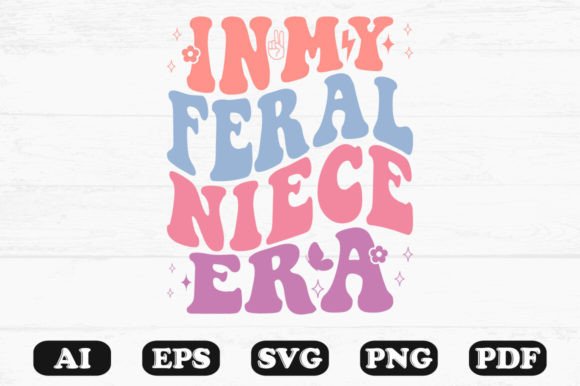
In My Feral Niece Era Retro Wavy SVG
As a designer who’s stitched thousands of custom pieces—from boutique sweatshirts to nursery pillow covers—I opened In My Feral Niece Era Retro Wavy SVG expecting playful irony and vintage charm. What I got was something more nuanced: a confident, slightly irreverent typographic statement with strong rhythmic flow and intentional imperfection. It’s not just “retro”—it’s *lived-in* retro, like a well-loved band tee from 1997 found folded in a cedar chest. That matters—especially when you’re translating it into thread.
First Impressions: Mood, Movement, and Embroidery Readiness
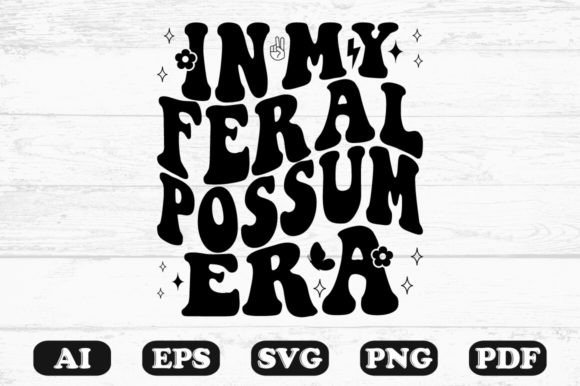
The wavy baseline is the first thing your eye locks onto—and that’s intentional. It’s not a gentle ripple; it’s a buoyant, uneven swell, giving the phrase kinetic energy. The letterforms are clean but deliberately uneven in weight and spacing, echoing hand-drawn signage or screen-printed gig posters. There’s no ornamentation, no extra flourishes—just rhythm, contrast, and personality. As an embroidery file, this works because it prioritizes legibility over intricacy. No tiny serifs, no overlapping strokes, no micro-details that vanish under satin stitch. That’s a win for real-world stitching.
A Real-World Test: Embroidering This on a Linen-Cotton Tote Bag
Last week, I used In My Feral Niece Era Retro Wavy SVG on a natural linen-cotton tote for a local maker’s market pop-up. Why a tote? Because it’s unforgiving: loose weave, minimal stretch, zero forgiveness for poor stitch density or weak stabilizer choice. I digitized it myself (since the product is an SVG—not a pre-digitized embroidery file), keeping stitch count lean: mostly satin stitch for outlines and moderate-density fill for interior letters. On the tote, it landed perfectly—bold enough to read at arm’s length, soft enough to feel handmade, not machine-perfect. Customers paused, smiled, and asked, “Is that yours?” That’s the quiet power of this design: it sparks conversation without shouting.
Where It Shines (and Where It Needs Caution)
In My Feral Niece Era Retro Wavy SVG excels in contexts where authenticity and light humor resonate: baby onesies (for the auntie who owns the narrative), oversized sweatshirts for teen gift bundles, embroidered patches for denim jackets, and kitchen towels for indie cafés. Its rhythm makes it ideal for curved surfaces like caps—if digitized with proper underlay and reduced density around the crown curve. It also holds up beautifully as a printable mockup asset for Etsy sellers building cohesive listings.
But be thoughtful: avoid using it raw on thin knit t-shirts without testing. The wave shape can exaggerate fabric distortion if stabilizer isn’t layered correctly. On dark fabrics, ensure your thread colors have enough contrast—the lowercase “e” and “c” in “Niece” sit low in the wave and can disappear if your navy thread blends too much with charcoal fabric. And skip it entirely for dense appliqué designs or layered embroidery projects; this is a standalone typography piece, not a background element.
What This Design Says About Your Brand (Without Saying a Word)
When your customer sees In My Feral Niece Era Retro Wavy SVG stitched cleanly on a handmade apron or baby blanket, they’re reading more than text—they’re reading tone, taste, and intention. It signals confidence in craft, comfort with levity, and awareness of contemporary sentiment (feral niece energy is real, relatable, and refreshingly unpolished). For Etsy sellers and small shop owners, that builds trust faster than five-star reviews. It doesn’t try to be everything—it owns its niche, and that makes finished products feel curated, not generic.
Practical Designer Notes Before You Stitch
- Always test on scrap fabric first—especially with textured weaves like linen or terry cloth. Watch how the wave interacts with grain direction.
- Check thread color contrast in both natural and artificial light. A warm mustard thread pops on oatmeal canvas but fades on heather grey.
- Review stitch density before hooping. Too dense? It’ll pucker. Too sparse? The wave loses definition. Aim for 3–4 passes on satin edges.
- Confirm hoop size compatibility. This design stretches horizontally—make sure your largest hoop accommodates the full width comfortably.
- Inspect small details at 200% zoom in your embroidery software. The subtle taper on the “f” and “r” in “Feral” must remain visible after stitching.
- Test black-and-white mockups—they reveal balance issues invisible in color previews.
- Use cutaway + tear-away stabilizer combo for structured items like tote bags; switch to lightweight tear-away for baby onesies.
- Verify licensing before selling finished products or bundling this SVG into digital embroidery kits. Since it’s listed as a Graphics product in Crafts, confirm commercial use rights directly with the creator.
Final Thought: Not Just a File—A Conversation Starter
In My Feral Niece Era Retro Wavy SVG isn’t about nostalgia for nostalgia’s sake. It’s about capturing a specific, affectionate cultural moment in a way that translates across mediums—digital mockup, heat-transfer vinyl, screen print, or, most meaningfully, machine embroidery. When stitched well, it becomes part of someone’s daily ritual: the tote they carry to farmers’ markets, the sweatshirt they wear to chaotic family reunions, the patch they sew onto their oldest backpack. That’s the mark of a truly functional design asset—not just pretty pixels, but a quiet, wavy pulse of recognition. Use it with care, test with honesty, and let its rhythm do the talking.