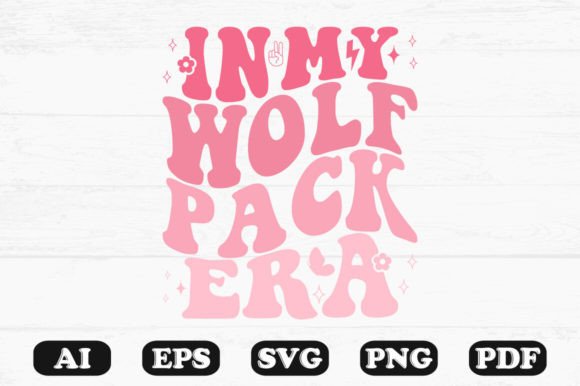
In My Wolf Pack Era Retro Wavy SVG
As a designer who’s stitched over 2,000 custom embroidery projects—from boutique baby onesies to Etsy best-selling tote bags—I opened In My Wolf Pack Era Retro Wavy SVG expecting charm. What I got was something more nuanced: a design that *feels* like a warm, confident inside joke—vintage in spirit but modern in wearability. It’s not just typography; it’s attitude with rhythm.
First Impressions: Mood, Flow, and Embroidery Readiness
The wavy baseline is the first thing your eye follows—not as a gimmick, but as intentional movement. It evokes 70s album art and sun-bleached denim jackets, but without the visual noise of overdone retro kitsch. The letterforms are clean, slightly condensed, with subtle weight shifts that suggest hand-drawn confidence—not rigid vector perfection. That’s good news for embroidery: organic flow translates well to satin stitch curves and gentle fill transitions.
I immediately pictured this on a heavyweight natural canvas tote for a local women’s co-op shop—something sturdy enough to hold groceries, soft enough to feel handmade, and bold enough to spark conversation. “In My Wolf Pack Era” isn’t just a phrase; it’s identity stitching. It reads clearly at 3.5" wide, holds up at 5", and still feels intentional even when scaled down to 2.75" on a child’s sweatshirt cuff.
Where It Shines (and Where It Asks for Help)
Best-fit real-world uses:
- Embroidered tote bag design — The wave’s horizontal span anchors the center panel beautifully; no awkward cropping or forced centering needed.
- Sweatshirt embroidery — Works especially well on raglan sleeves or lower-back placement where the curve echoes the garment’s drape.
- Personalized gift — Ideal for graduation, new job, or friend-group milestones. Customers respond to phrases that feel authentic, not generic.
- Small shop product — Fits cleanly into curated collections: “Retro Resilience,” “Squad Energy,” or “Quiet Confidence” themes.
- Digital embroidery file for craft business owners who bundle SVG + PES + DST files—this design bridges graphic appeal and stitch logic.
Use with thoughtful prep:
- Small hoop sizes (under 4"): The wave’s outer arcs may need trimming or repositioning. Test stitch on scrap first—don’t assume automatic scaling preserves rhythm.
- Textured fabrics (terry cloth, bouclé, heavy linen): The wavy line can blur if stabilizer isn’t firm enough. Use cutaway + topping for crispness.
- Stretchy fabric (ribbed knits, lightweight jersey): The phrase’s length makes it prone to distortion. Hoop with light spray + medium-weight tear-away.
- Dark fabric: Light thread colors (cream, pale sage, soft gold) read beautifully—but avoid pastel pinks or yellows unless you’re using high-contrast underlay.
- Curved surfaces (caps, beanies): The wave works *only* on front panels with flat-to-gentle-curve zones. Skip the crown or back strap unless you’re digitizing a custom version.
What It Does for Your Brand—and Your Buyers
This isn’t just another text-based machine embroidery design. It carries tonal weight. When stitched on an apron for a female-led bakery, it signals community—not competition. On a baby embroidery onesie? It’s tender irony (“My wolf pack starts with naptime”). That duality builds trust: customers see intention, not inventory.
For Etsy sellers and small shop owners, In My Wolf Pack Era Retro Wavy SVG supports brand consistency without demanding uniformity. Pair it with minimalist mountain silhouettes or neutral-toned patches—it doesn’t clash. It *complements*. And because it’s rooted in typography—not clipart—it elevates perceived value. A $38 embroidered pillow cover feels like a keepsake, not a craft fair impulse buy.
That said, it’s not universal. It won’t land the same on corporate swag or formal wedding gifts. Its strength is in authenticity—not polish. Lean into that.
Practical Designer Notes Before You Stitch
Before loading In My Wolf Pack Era Retro Wavy SVG into your embroidery software or listing it as a digital embroidery file:
- Test on scrap fabric matching your final project’s weight and stretch—even if it’s “just text.” Waves behave differently on cotton poplin vs. French terry.
- Check thread color contrast in both natural and artificial light. Some “cream” threads look gray under LED displays—a problem for online mockups.
- Review stitch density. If your version includes dense fill behind letters (not just outlines), confirm it won’t pucker thin fabrics or overwhelm baby embroidery.
- Confirm hoop size compatibility. If you’re selling finished products, know your standard hoop limits—and whether this design fits comfortably within them.
- Inspect small details: Are serifs or terminal curves too fine for 60–70 wt thread? Zoom in digitally before stitching.
- Test black-and-white mockups. This design relies on shape and rhythm—not color—so grayscale previews reveal clarity issues fast.
- Compare light and dark fabric backgrounds side-by-side. What reads as playful on oatmeal canvas may vanish on charcoal heather.
- Use proper stabilizer—especially for wavy lines. A floating bobbin or weak top layer distorts the curve faster than straight text.
- Verify licensing. Since this is listed as a Graphics product in Crafts, confirm whether commercial use (e.g., selling embroidered totes on Etsy) is permitted—some SVG bundles restrict resale of physical items.
Bottom line? In My Wolf Pack Era Retro Wavy SVG earns its place in a working designer’s library—not because it’s trendy, but because it stitches true, sells with story, and stays legible across real-life textures, tensions, and timelines. It’s the kind of design that starts conversations, not just fills space.